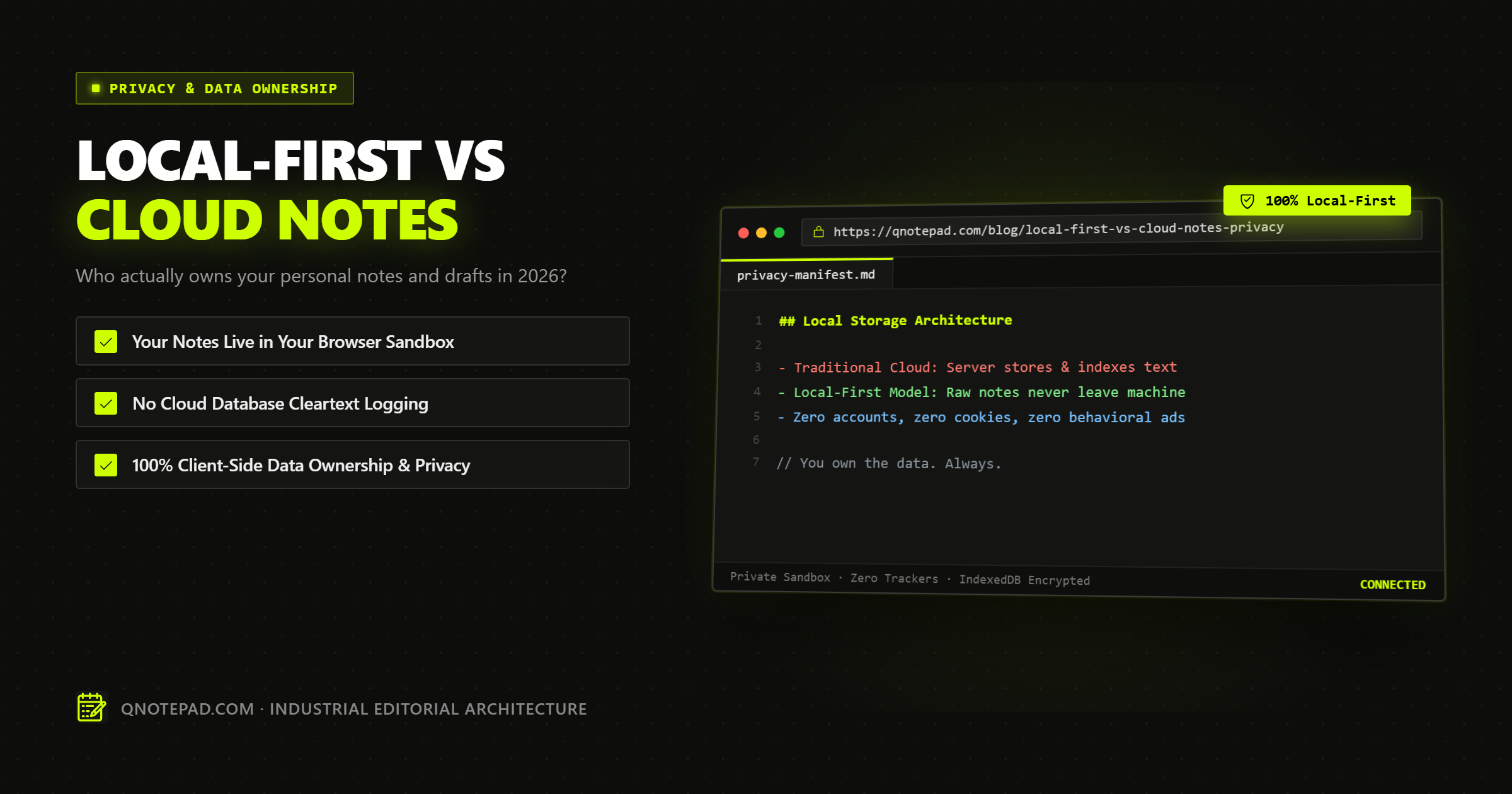
When you type a private draft, personal journal entry, financial plan, or internal company secret into a standard cloud note application, you are entering an implicit bargain. You trade complete operational control of your data for the convenience of centralized synchronization.
In recent years, that trade-off has become increasingly fraught. Terms of Service updates routinely grant vendors broad licenses to inspect user content for algorithmic training, content moderation, or ad targeting. Server breaches continue to expose millions of cleartext notes.
The Local-First software movement presents a modern architectural alternative: what if your software gave you the convenience of the modern web while keeping all data storage, processing, and control strictly on your own physical hardware?
In this guide, we break down the fundamental technical differences between Traditional Cloud Notes and Local-First Architecture, and how modern browser primitives enable true digital sovereignty in 2026.
The Hidden Vulnerabilities of Centralized Cloud Notes
Most major cloud note-taking platforms (such as Evernote, Google Keep, Notion, and standard collaborative wikis) rely on a server-authoritative model. In this model:
- Cleartext Server Indexing: Even when data is "encrypted at rest," the encryption keys are managed by the cloud provider. The provider's backend decrypts your notes on their servers to power server-side search, generate link previews, or run content analysis.
- Third-Party Subpoena Risk: If a cloud provider receives a valid legal warrant or government subpoena, they are legally compelled to provide your decrypted notes. You have zero cryptographic recourse because you do not hold the keys.
- AI Training Ingestion: Several major productivity suites have quietly updated their privacy policies to allow automated scanning of customer content to train predictive models and large language models (LLMs).
- Permanent Vendor Lock-In: Exporting your data often results in lossy, proprietary JSON formats or broken markdown with missing asset attachments, ensuring you remain dependent on their subscription.
Architectural Comparison: How Data Flows
Understanding the difference between cloud and local-first architecture comes down to where the primary source of truth resides.
Traditional Cloud Architecture
[Your Browser]
      │ (Keystrokes sent over network)
      ▼
[TLS Tunnel]
      │
      ▼
[Centralized Application Server] ──► [Server Memory Decrypts Cleartext]
      │                                       │
      ▼                                       ▼
[Master Cloud Database]              [Background AI / Indexing Workers]
In this architecture, your browser is merely a display terminal. If your internet connection drops, the app disables features or freezes. If the server experiences an outage, your notes are unreachable.
Local-First Web Architecture (QNotepad)
[Your Browser Runtime]
      │ (Zero Network Call on Keystrokes)
      ▼
[Client-Side Sandbox Storage (IndexedDB)] ──► [100% Offline Persistence]
      │
      ▼ (Only when user explicitly shares or backs up)
[Web Crypto Client-Side AES-256-GCM] ──► [Encrypted Ciphertext Only]
      │
      ▼
[Blind Edge CDN Storage] (Holds no keys; cannot read content)
In a local-first system, your local device is the primary source of truth. The network is treated as an optional secondary synchronization mechanism rather than an essential runtime dependency.
Comparative Matrix: Privacy, Speed & Ownership
| Evaluation Dimension | Traditional Cloud Notes | Local-First Architecture (QNotepad) |
|---|---|---|
| Primary Data Location | Remote cloud database (AWS, GCP, Azure) | Your local browser sandbox (IndexedDB) |
| Offline Reliability | Broken or severely limited | 100% functional without internet |
| Startup to Typing Speed | 1,500ms - 3,500ms (Network dependent) | Under 50ms (Zero network roundtrips) |
| Key Ownership | Vendor manages KMS keys | User device holds encryption keys |
| Vendor Surveillance | Vendor can inspect, scan, or train on notes | Technically impossible (Server is blind) |
| Account Requirement | Mandatory sign-up and email tracking | None (Open URL and type immediately) |
| Data Longevity | Dies if company shuts down or bans account | Survives indefinitely in local exports / storage |
The 7 Core Principles of Local-First Software
The local-first paradigm, originally formalized by researchers Martin Kleppmann, Adam Wiggins, Peter van Hardenberg, and Mark McGranaghan, establishes seven critical design principles:
1. No Spinners: Your Work is Always Local
Every keystroke, cursor movement, and document edit updates local storage synchronously. The user interface never halts to wait for a server acknowledgement or roundtrip handshake.
2. The Network is an Optional Enhancement
A local-first application works identically whether you are in airplane mode, connected to spotty train Wi-Fi, or streaming gigabit fiber. The application never refuses to open or edit because of network failure.
3. Seamless Asynchronous Sync
When network access is available, local-first systems synchronize state across devices using conflict-free resolution algorithms or ephemeral encrypted channels, without demanding continuous server connection.
4. The Long Now: Longevity Beyond Vendors
Software companies shut down, get acquired, or change pricing tiers. A local-first application stores data in standard formats (Plain text, Markdown, standard JSON, SQLite) so your notes remain readable decades from now, even if the original application ceases to exist.
5. Security and Privacy by Default
Because your primary data lives on your device, you do not rely on legal privacy promises or vendor compliance audits. Security is enforced by computer science: end-to-end encryption with client-held keys ensures that servers only ever handle opaque ciphertext.
6. User Retains Ultimate Ownership
In traditional software, you rent access to your data from a platform provider. In local-first software, you possess the files on your physical machine, with full rights to back up, copy, migrate, or delete them at will.
7. Multi-Device Accessibility Without Sacrificing Privacy
Modern browser APIs—such as the Web Crypto API paired with RFC 3986 capability URLs—allow local-first tools to provide seamless peer-to-peer sharing and sync without ever leaking cleartext content to server storage.
How to Audit Your Current Note-Taking Tool for Privacy
To verify whether your current note application respects true local-first privacy, ask these three diagnostic questions:
- Can you access and edit all your notes with your Wi-Fi physically disabled? If the application shows a blank loading spinner or blocks edits, it is a cloud-dependent tool.
- Does the company require an email, phone number, or social login before you can write? If so, your identity is linked to your data profile from day one.
- If the company's servers are seized or breached tomorrow, can anyone read your notes? If the company does not offer client-side zero-knowledge encryption, the answer is yes.
The Verdict: Why Local-First is the Future of Note-Taking
The convenience of cloud software does not require surrendering your privacy. By building on modern browser standards—local IndexedDB persistence, client-side cryptographic primitives, and service workers—tools like QNotepad deliver sub-50ms instant writing speed while guaranteeing that your personal thoughts remain exclusively yours.
Test Local-First Private Notes in QNotepad →
No login, no cookies wall, no servers looking over your shoulder. Write locally with zero latency.